 Folio Launcher
After jailbreak
I have been in this since iOS 7 or 8. Folio exists because I missed it, and because the thing I missed is not coming back to the iPhone in my pocket.
What actually happened
Jailbreaking is not dead, and anyone telling you it is has not looked lately. Dopamine 3.0.10 came out on 23 September 2026, and it reaches iOS 26. The catch is the hardware: A12 and A13 only, which means the iPhone XS, XR, 11 and 11 Pro. For an iPhone with an A14 chip or newer, the ceiling is iOS 17.3.1.
So the honest sentence is narrower and worse: there is no public jailbreak for any iPhone Apple has sold since 2020. The person who maintains that jailbreak said why plainly in its release notes, pointing at the lack of a bypass for the protection Apple added in iOS 17.4.
Why it got harder
Apple kept adding layers, and each one is in its own security guide: pointer authentication from A12, page protection from A12, then SPTM and TXM from A15, which stop page tables being modified even with a kernel write. A19 adds memory integrity enforcement. A jailbreak that used to need one bug now needs a chain of them.
The people who found those bugs also got expensive to compete with. Apple's bug bounty went to two million dollars for a zero-click chain in October 2025, and some of the best-known tweak developers now work at Apple, including the author of Taurine, hired in May 2024. His jailbreak has not been touched since October 2023.
The shops closed
Cydia stopped taking payments in December 2018. Its author sued Apple, and in December 2023 the Ninth Circuit affirmed the dismissal on a four-year time limit rather than on whether the claim was right. A rehearing was denied in March 2024. The site is still up, still telling you to jailbreak with tools from iOS 9.
The repositories went the same way, unevenly. Packix archived itself in August 2022 and still serves 3,773 frozen packages, which is as good a picture of this as any. Havoc is still alive, with about 3,500 packages and an index rebuilt this morning. Sileo, the package manager most people use, had its last release in October 2024.
What Apple took, and kept
The ideas did not die. They shipped, in iOS, usually years later and without a word about where they came from.
| Apple feature | Shipped | The tweak that did it first |
|---|---|---|
| Control Center | iOS 7 | SBSettings |
| Dark Mode | iOS 13 | Eclipse |
| Home screen widgets | iOS 14 | HSWidgets |
| App Library | iOS 14 | Vesta |
| Lock screen customization | iOS 16 | Complications |
| StandBy | iOS 17 | Photon |
| Custom app icons, hidden labels | iOS 18 | Winterboard, by Cydia’s author |
| Third-party Control Center toggles | iOS 18 | CCSupport, by the developer who still maintains Dopamine |
Apple has never acknowledged any of this, and "stole" is the community's word rather than a fact. What is documented is that each feature existed as a tweak first.
Why alternative app stores did not replace it
Europe's rules made other iPhone app stores legal in March 2024, and AltStore PAL is real and running. It is still not a replacement, for a reason that has nothing to do with Apple's mood: every app is notarized and signed by Apple whatever store it comes from, and the sandbox does not change. Apple's own rules for that review say an app may not read or write outside its container, and may not download or run code that changes another app's behaviour. That is the definition of a tweak.
It bites in practice. In June 2024 Apple refused to notarize UTM SE, which blocked it from those European stores entirely, not just the App Store. Different shop, same locks.
What Android still lets you do
Replacing the home screen on Android is not a hack or a loophole. A launcher is an ordinary app that says it can be the home screen, and you pick it in Settings. No root, no exploit, no signing games. That is the whole reason Folio can exist at all.
There is an irony worth saying out loud: even here, the richest customization layer is a community convention rather than a platform feature. Icon packs have no Android API. They work because launcher developers agreed on a file format years ago and kept honouring it.
Android is narrowing too. From 2027, apps on certified devices will need to come from a verified developer, which is identity checking rather than app review, and does not limit what an installed app may do.What that means for installing Folio.
Which brings us to the Market
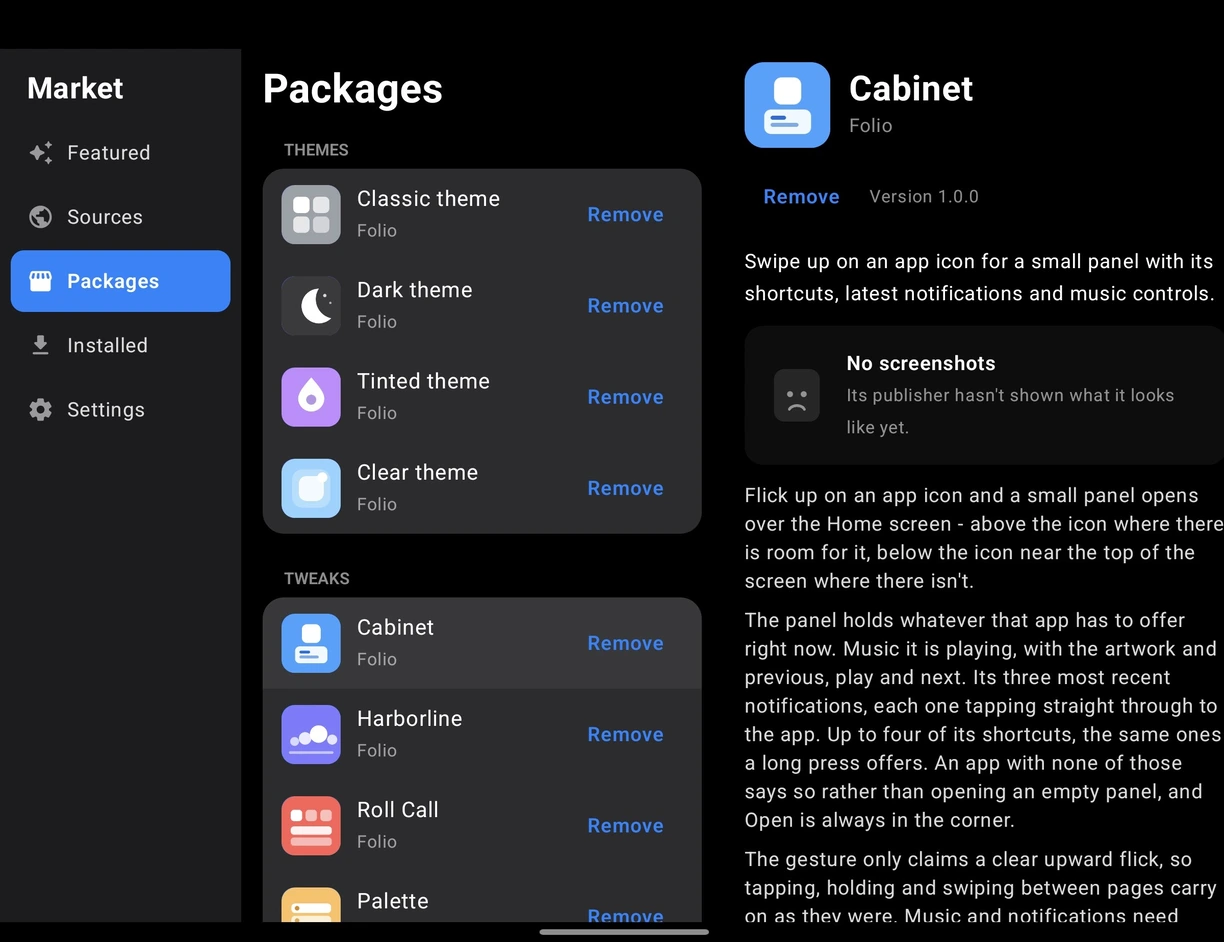
Folio's Market is the Cydia and Sileo idea, on a platform that still allows it: sources you add yourself, packages with a page each saying what they change and what they cannot reach, signatures checked before anything is applied, and Undo beside it.
Five tweaks are there now, rebuilt from the ones I missed rather than ported, with everyone credited. In 0.7.0 the Market opens to everyone, and anyone can publish a source of their own.
And it does not have to look like iOS
Folio started as the iPhone home screen I wanted on Android, and that was the first step, not the whole plan. Where it is heading is a full launcher: one you choose because it is clean and does not reek of ads, whether or not you want it to look like an iPhone.
So if you are here for a better Android launcher rather than an iPhone one, do not worry. There will be options.
The only thing supporting buys is earlier: betas sooner, and a few extras. Nothing that already works moves behind it, and you should not feel you have to.
Free, and staying that way
5.1 MB, Android 12 and up. No ads, no analytics, no account.
Where these facts come from
- Dopamine releases, for what is jailbreakable today and why it stops.
- Apple's own security guide, for PAC, PPL, SPTM and TXM.
- Apple Security Bounty, October 2025.
- TechCrunch, on Cydia closing purchases, and the Ninth Circuit's decision.
- Wikipedia's tweak-to-feature table, which is sourced tweak by tweak.
- Apple on alternative distribution in the EU and its notarization rules.